
The Digital Oilfield Starts at the Wellhead.
Upstream production operations generate enormous volumes of real-time data — from downhole sensors and surface drives to separators, tanks, and injection pumps. The challenge is not acquiring that data. The challenge is turning it into operational intelligence fast enough to matter.
When a well trips at 2am in a remote location, every minute of downtime is deferred production. When an ESP is running at degraded efficiency for weeks without detection, the cost accumulates invisibly. When a sucker rod pump is operating outside its design envelope, the failure is predictable — but only if someone is watching.
Optima's Field Automation & Monitoring solution ensures someone is always watching — automatically, intelligently, and across your entire asset base simultaneously.
Complete Coverage -
Every Lift Type, Every Asset
- ESP Wells — SCADA Monitoring 01
- Sucker Rod Pump (SRP) Wells.. 02
- Gas Lift Wells — Monitoring.. 03
- Water Injection & Disposal.. 04
- Process Equipment.. 05

ESP Wells — SCADA Monitoring
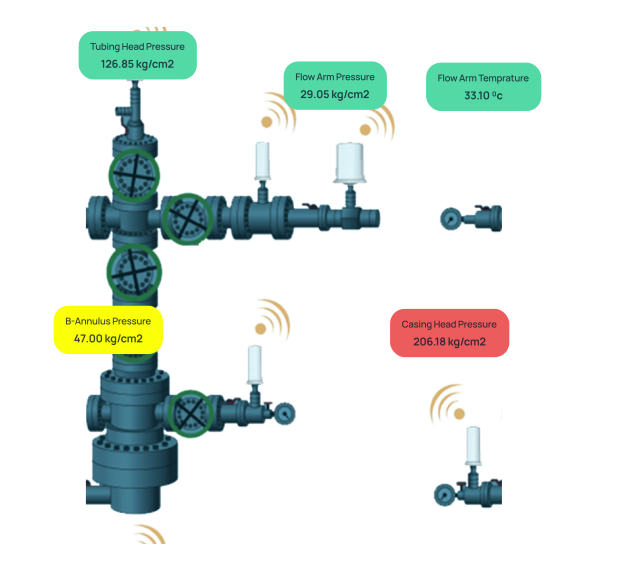
Real-time monitoring of all critical ESP operating parameters from SCADA — motor current, voltage, frequency, vibration, temperature, intake and discharge pressure.
Tracks pump performance, runtime, and efficiency indicators against design benchmarks.
Detects abnormal operating conditions and early failure signatures — including motor overload, gas locking, pump cavitation, and downthrust events.
Generates severity-classified alerts for rapid operational response — with full alarm history and acknowledgement tracking.
Adjustable data frequency to capture high-resolution transient events or optimise transmission bandwidth.

Sucker Rod Pump (SRP) Wells — Monitoring & Diagnostics
Real-time monitoring of SRP operating parameters: pump fillage, loads, strokes per minute, stroke length, motor current, and production rates.
Dynamometer card acquisition and AI-pattern diagnosis — automatically classifying well conditions across 13+ failure modes including gas interference, fluid pound, travelling valve leak, stuck rod pump, broken sucker rod, and tubing leaks.
Historical trend analysis and graphic tiling across all SRP wells simultaneously.
Uptime and downtime tracking with root cause classification for every event.
Balance analysis and frequency optimisation recommendations derived from real-time card data.
Electric diagnosis using Big Data statistical benchmarks for current and voltage alarm thresholds.
%20Wells.svg)

Gas Lift Wells — Monitoring & Event Detection
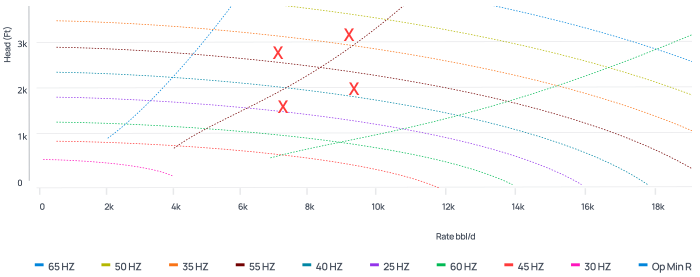
Real-time monitoring of gas injection rate, casing head pressure, flowing tubing pressure, and flowline temperature.
Automated event detection for the five primary gas lift failure modes: orifice plugging, stuck valve, choke erosion, tubing leak, and high gas-oil ratio.
Machine learning trend analysis to identify progressive instability, under-injection, and slug flow conditions.
Correlation plots for data analytics and troubleshooting identification. Alarm management, remote settings, and reporting integrated within the same Digital Oilfield environment.

Water Injection & Disposal Wells
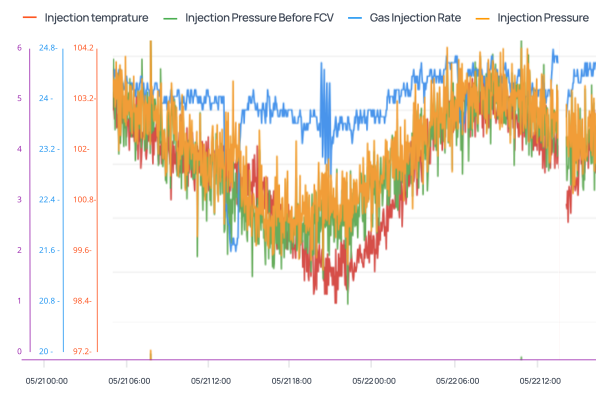
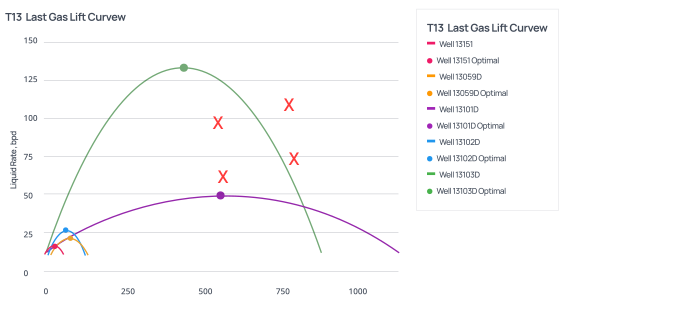
Real-time monitoring of injection rate, wellhead tubing and annulus pressure, and injectivity performance.
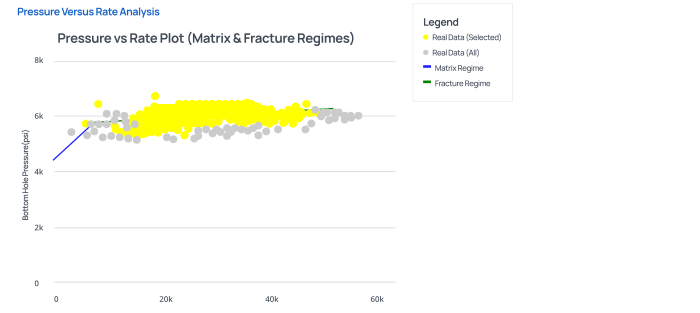
Event detection for plugging and fracturing events.
Integration with the Production Surveillance module for Hall plot injectivity analysis and disposal optimisation.
Remote settings, alarm management, and full operational reporting.

Process Equipment — Facilities Monitoring
Comprehensive monitoring of separators, heater treaters, desalters, pumps, compressors, and tanks — with real-time flow rates, levels, pressures, and temperatures.
Process equipment event tracking and troubleshooting workflows. Remote process control via SCADA panel — separator, heater treater, and tank management from within Optima.
Asset uptime and downtime tracking with KPI generation for operational reliability reporting.
Good Decisions
Require Good Data
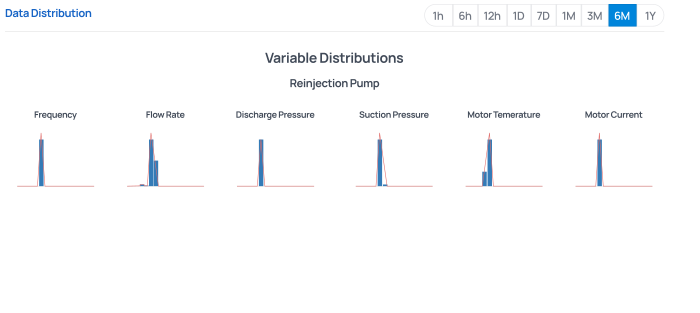
A Digital Oilfield is only as reliable as the data that feeds it. Optima's Field Automation & Monitoring solution includes a dedicated data quality management layer that monitors the availability, completeness, and consistency of all sensor and SCADA data — flagging gaps, communication failures, and measurement anomalies before they corrupt operational decisions.

Data Availability Monitoring
Tracks sensor data completeness across all assets and time periods. Identifies communication gaps and instrument failures with distribution plots by well and asset type.

Asset Control Integrity
Monitors uptime, critical parameter thresholds (SEC, health score, efficiency), and event counts by asset — providing a single-view integrity status across the entire field.

Sand Management
Real-time sand production monitoring uses field sensors and lab data to track sand rate, concentration (lb/1000 bbls, ppm), and operating conditions, with alerts and compliance reporting.

Asset Uptime & Downtime KPIs
Automated uptime and downtime tracking using real-time SCADA data generates well- and field-level KPIs, quantifies production losses, and supports reliability improvement programs.

.svg)
Change setpoints
Modify operating parameters remotely without a field visit.

.svg)
Change frequency
Adjust VSD frequency on ESP or SRP wells to optimise production or protect equipment.

.svg)
Start / Stop pump
Remotely start or stop any pump with write access, from any location.
Change other parameters
Any parameter with write access in the SCADA system can be modified through Optima's secure control interface.
The Foundation That
Powers Every Other Solution.
Field Automation & Monitoring is the operational foundation of the Optima Digital Oilfield. The real-time SCADA data it acquires and contextualises feeds every other module in the platform — from Virtual Flow Metering and production surveillance to nodal analysis, ALS failure prediction, and Digital Twin calibration. Deploy it as your starting point, or integrate it into an existing Optima deployment to add real-time field intelligence to your analytics and optimisation workflows.
%20Reduced%20Deferred%20Production.svg)

Production Surveillance
Event detection feeds alarm management and well prioritisation.
%20Lower%20Remediation%20Costs.svg)

Production Optimization
SCADA data provides continuous calibration for nodal analysis and flow assurance models.
%20More%20Accurate%20Production%20Accounting.svg)

Artificial Lift Lifecycle
Operational data feeds ALS diagnostics, failure prediction, and energy optimisation.
%20Proactive%20Maintenance%20Planning.svg)

Digital Twin
Real-time field data synchronises digital twin models for simulation and training.


Envision
The IoT gateway that connects your wellsite to Optima.


Continuously Improving Accuracy
ML recalibration means the Digital Twin gets more accurate over time — not less. As your field evolves, so does the model that represents it.
Take control of your
artificial lift programme.
Speak with our ALS specialists and discover how Optima's Artificial Lift Lifecycle solution can reduce your lifting cost, extend run life, and give you full visibility across your entire ESP and ALS operation.