
Electrical Consumption
is Your Largest Controllable Cost. Are You Controlling It?
Electrical Submersible Pumps are among the most energy-intensive pieces of equipment in upstream production. In fields with large ESP populations, electrical consumption can represent 30–50% of total operating expenditure. Yet most operators lack the tools to monitor energy consumption at the individual well level, let alone identify which wells are operating inefficiently or quantify the cost of that inefficiency.
The result is a significant and persistent source of hidden OPEX — electrical costs that accumulate well by well, month after month, without being systematically identified or addressed.
Optima's Electrical Optimisation solution changes that. It makes energy consumption visible, measurable, and manageable — at the well level, the field level, and the portfolio level — and integrates that visibility directly into the operational decision-making environment of the Digital Oilfield.
Measure. Benchmark.
Optimise. Report.
- Specific Energy Consumption.. 01
- ML-Driven Inefficiency.. 02
- Cost-Benefit Analysis.. 03
- Integrated Energy & Production.. 04

Specific Energy Consumption Tracking (kWh/bbl)
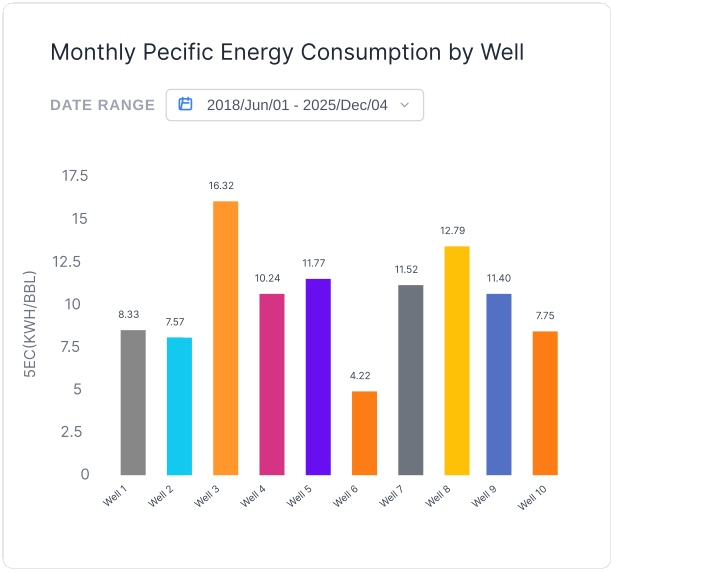
Calculates specific energy consumption — kilowatt-hours per barrel of liquid produced — at the individual well level and aggregated to field and portfolio level.
Provides the primary benchmark for comparing ESP efficiency across the well population — identifying outliers and ranking wells by energy cost per barrel.
Tracks kWh/bbl trends over time — distinguishing genuine efficiency deterioration from changes in production rate or fluid composition. Well-level comparison dashboards: visual ranking of ESP wells by specific energy consumption to prioritise optimisation activity.
Decision support: clear, actionable recommendations for each detected event.

ML-Driven Inefficiency Detection
Machine learning models monitor energy consumption patterns continuously — identifying wells that deviate from expected efficiency benchmarks given their operating conditions.
Distinguishes between inefficiency caused by equipment degradation, operating point mismatch, or suboptimal VSD settings — enabling the right corrective action.
Generates actionable alerts when a well crosses configurable efficiency thresholds — prompting engineering review before cost accumulates further.
Quantifies the savings opportunity for each candidate well — supporting prioritisation of optimisation activities by economic impact.

Cost-Benefit Analysis — Transition Planning
Evaluates the cost-benefit of reducing electrical consumption through operational changes — VSD frequency adjustment, downsize pump selection, or transition to an alternative lift mechanism.
Compares current lifting cost against projected cost under alternative configurations — using actual field data rather than design assumptions.
Supports informed investment decisions: when does upgrading to a more efficient pump justify the intervention cost? Optima provides the data to answer that question objectively.
Streamlines transition planning with scenario modelling built into the same Digital Oilfield environment as operational monitoring.

Integrated Energy & Production Optimisation
Balances production output, power consumption, and lifting cost simultaneously — combining technical and economic variables to identify the optimal operating point for each ESP well.
Continuous lifecycle improvement: operational and failure data feeds energy optimisation models — progressively reducing OPEX and tracking energy cost impact over time.
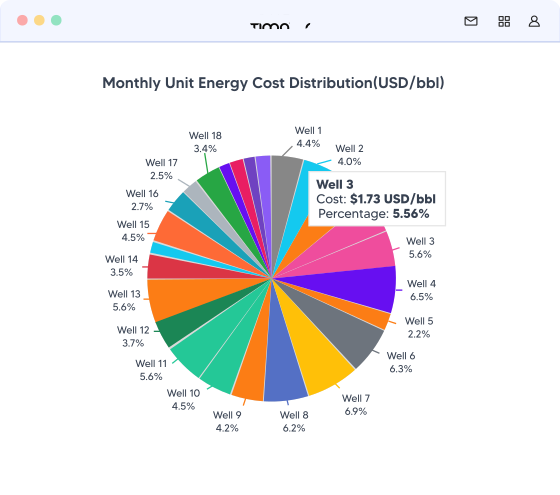
Distribution of lifting costs across the ESP fleet — with portfolio-level dashboards for management reporting and capital allocation decisions.
ESG Reporting Built Into
Your Digital Oilfield —
Not Added Afterwards.
Reducing electrical consumption in upstream operations is not only an economic imperative — it is an increasingly important ESG commitment. Investors, regulators, and operating partners are asking upstream operators to quantify and reduce the energy intensity of their production activities.
Optima's Electrical Optimisation solution provides the data infrastructure for that reporting — tracking energy consumption at the asset level, estimating CO₂ emissions from electrical use, and generating the compliance-ready outputs that ESG reporting frameworks require.
This is not a separate ESG module added to the platform. It is energy intelligence embedded in the Digital Oilfield — produced as a natural output of the same monitoring and analytics that drive operational decisions.
ESG Capabilities
CO₂ emissions estimation from electrical consumption — well level and field level
Energy intensity tracking (kWh/bbl) as a primary operational and ESG performance metric
Flared gas volume monitoring integrated via the Production Workflow module — supporting Scope 1 emissions reporting
Trend reporting and period comparisons to demonstrate year-on-year energy efficiency improvement
Exportable reports in formats compatible with standard ESG reporting frameworks
What Electrical
Optimisation Delivers
%20Reduced%20Deferred%20Production.svg)

Reduced Lifting Cost per Barrel
Systematic kWh/bbl optimisation across the ESP fleet reduces the most controllable component of lifting cost — with measurable impact on field-level OPEX.


Extended ESP Run Life
Operating ESPs at their most efficient point reduces thermal and mechanical stress — contributing to extended run life alongside the failure prediction capabilities of the AL Lifecycle module.


Informed Capital Allocation
Cost-benefit analysis of pump transitions and equipment upgrades is grounded in actual field data — enabling investment decisions that deliver real returns rather than estimated savings.


ESG Compliance Readiness
CO₂ estimation and energy intensity tracking deliver the data infrastructure for ESG reporting — without additional systems, manual calculation, or third-party data aggregation.
Find out what your ESP operations are really costing you – per barrel.
Talk to our team and discover how Optima's Electrical Optimisation solution can be deployed across your ESP well portfolio — identifying inefficiency, reducing lifting cost, and delivering the ESG data your stakeholders are asking for.