
You Cannot Optimise What You Cannot See — Continuously.
Most operators test their wells monthly — at best. In the intervals between well tests, production conditions change, equipment degrades, and flow rates drift. By the time the next test reveals the problem, weeks of deferred production have already been lost.
Real-time production surveillance eliminates that blind spot. Optima continuously estimates flow rates, tracks operating conditions, monitors asset health, and identifies anomalies across every well in your field — without waiting for the next scheduled test or the next field visit.
The result is a production surveillance capability that works at the pace of your field, not the pace of your testing schedule.

Real-time oil, water, and gas rate estimation using a hybrid approach combining artificial lift physical models, continuous calibration with historical well test data, and machine learning algorithms

Dynamic model adjustment according to the active artificial lift system — automatically recalibrated as field conditions evolve.

Resilient to partial or total sensor data loss — the model adapts using historical patterns, machine learning, and time-series analysis to continue delivering reliable estimates.

Continuous calibration against validated well test data to maintain accuracy over the life of the well.

95% estimation accuracy validated against physical metering across active deployments.
Detect What Your Team
Cannot Watch 24/7.
Optima's event detection engine runs continuously across every monitored well — identifying anomalies, classifying failure signatures, and flagging wells that require intervention, before a trip occurs.
- ESP Event Detection 01
- Gas Lift Event Detection 02
- SRP Event Detection... 03

ESP Event Detection
Structured historical logging of all ESP failures – downhole and surface – to continuously train and improve predictive models.
AI-driven anomaly detection: Hybrid machine learning models identify deviations in electrical, hydraulic, mechanical, and environmental variables.
Clustering algorithms discover progressive degradation patterns and anomalous well behaviour across the ESP fleet.
Wells categorised by operational risk level – enabling proactive intervention prioritisation before failure occurs.
Decision support: clear, actionable recommendations for each detected event.

Gas Lift Event Detection
Automated detection of five primary gas lift failure modes: orifice plugging, stuck valve, choke erosion, tubing leak, and high gas-oil ratio.
Machine learning trend analysis distinguishes genuine operational events from normal operating variability.
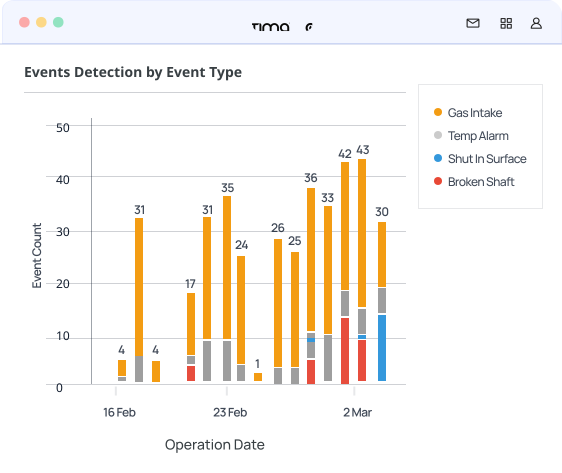
Event dashboard showing detection count by well and by event type — with trend distribution across the field.

SRP Event Detection — Dynamometer Card Diagnosis
AI pattern-matching technology — similar to face recognition, applied to dynamometer card shapes — classifies well operating conditions across 13+ failure modes.
Detects: natural flowing, normal operation, lack of supply liquid, severe liquid starvation, gas lock, gas interference, tubing leak, fluid pound, travelling valve leak, standing valve leak, broken sucker rod, stuck rod pump, and offline conditions.
Production calculation from card diagnosis: derives actual vs. theoretical production rates from pump diagram characteristics.
More Signal. Less Noise.
Faster Response.
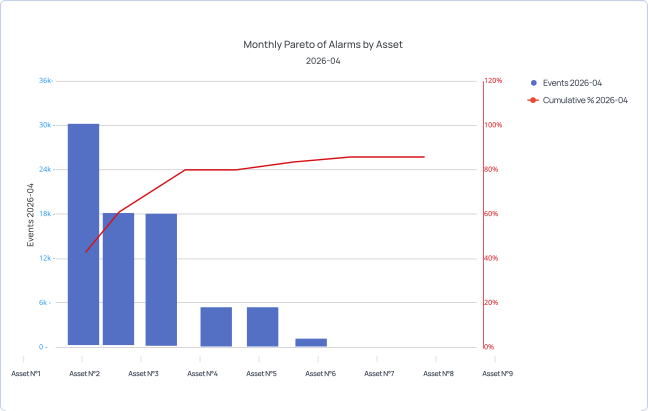
Alarm fatigue is one of the most persistent challenges in upstream production operations. When every well generates hundreds of alarms and every alarm demands attention, the critical events get buried in the noise. Optima's alarm management system changes the relationship between operators and their alarms — from reactive noise management to proactive, prioritised operational response.
- Centralised real-time alarm feeds from SCADA and field systems across all assets.
- Intelligent filtering, prioritisation, and contextualisation — separating critical conditions from nuisance alarms.
- Severity-based classification ensuring the most urgent events receive immediate attention.
- Email acknowledgement workflows and automated notifications to responsible stakeholders.
- Full alarm history, dashboards, and reporting for operational review and compliance.
- Configurable alarm thresholds per asset, lift type, and operating condition.
- ESP alarm settings management — with automated threshold definition using Big Data statistical benchmarks
Operational Completeness —
Beyond the Producing Well.

%20Well%20Test%20Validation.svg)
Well Test Validation
Validates actual well test data against nodal analysis simulations and VFM estimates — ensuring consistency across the production database.
Configures well test simulators (multi-rate, multi-pressure, VFM) for daily production calibration.
Model tuning workflow triggered automatically when actual test data is available.
Supports the complete well test plan management workflow — from scheduling and execution tracking through to result validation and database update.

%20Water%20Disposal%20Management.svg)
Water Disposal Management
Monitors disposal wells and injection pump performance using real-time SCADA data.
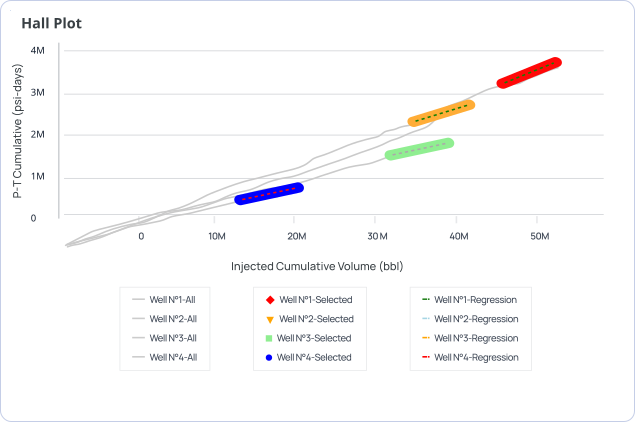
Evaluates injectivity trends and pressure behaviour over time. Applies industry-standard analytical methods — Hall plots, Hall Injectivity Index, Slevinsky, Hearn Plot, and Instantaneous Injectivity Index — to detect plugging events and fracture response.
Visualises cumulative water volume injected, injection rate trends, and injectivity index history by well.
Supports capacity forecasting and optimisation of disposal operations.
Your Entire Field. One View.
Optima's Production Surveillance dashboard opens with a map view showing all wells, pads, and field infrastructure — colour-coded by real-time status. From a single screen, your production team sees which wells are producing, which are shut-in, which have active alarms, and which the system has flagged as priority candidates for attention. Drill into any well for full SCADA trends, VFM data, event history, alarm status, and production analytics — all in one place, without switching between systems.
What Production
Surveillance Delivers
%20Reduced%20Deferred%20Production.svg)

Reduced Deferred Production
Identify and address well performance issues faster — cutting the time between event onset and corrective action, and recovering production that would otherwise be permanently deferred.
%20Lower%20Remediation%20Costs.svg)

Lower Remediation Costs
Early detection reduces the severity and cost of interventions. Catching a failing ESP before it trips avoids a full workover; detecting a gas lock early prevents motor burn.
%20More%20Accurate%20Production%20Accounting.svg)

More Accurate Production Accounting
VFM data continuously fills the gaps between well tests — giving your production accounting team more accurate daily figures without additional metering infrastructure.
%20Proactive%20Maintenance%20Planning.svg)

Proactive Maintenance Planning
ML-driven failure prediction and risk categorisation enable your team to plan maintenance activities around production priorities — not emergency call-outs.
Stop reacting.
Start anticipating.
Talk to our team and see how Optima's Production Surveillance solution can be deployed across your well portfolio — with a demonstration tailored to your lift types and field conditions.