
.svg)

.svg)
Equipment tracking:
Where is every pump, motor, seal, and cable in the system — in the well, in transit, in the repair centre, or in inventory? Without end-to-end traceability, inventory is duplicated, lead times extend, and slow-moving stock accumulates.

.svg)
Performance and reliability:
Which wells are approaching failure? Which equipment configurations are delivering the best run life in your specific operating conditions? Without data-driven failure prediction and MTBF analysis, interventions are reactive and expensive.

.svg)
Energy efficiency:
ESP operations account for a disproportionate share of field electrical consumption. Without well-level kWh/bbl tracking and optimisation, inefficiency compounds invisibly — adding cost without reducing production.
Optima's Artificial Lift Lifecycle solution addresses all three — in a single integrated Digital Oilfield environment.

Job Management
End-to-end job tracking from contract signature and purchase order through equipment selection, testing, preparation, shipment, installation, backloading, warehouse receipt, repair, and scrap — with full status visibility at every stage.

Equipment Tracking
Well data, daily diagnosis, equipment specifications, inventory status, settings, and alarm history maintained in a live database for every ESP unit and ALS component in the system.

ESP Cable Lifecycle
Granular tracking of cable inventory, usage, cutting, splicing, reuse, and reinstallation across multiple runs. Automated serial numbering and cable movement history — managing the 40% of ESP system cost that most operators track in spreadsheets.

Automated Documentation
System-generated install job reports, pull job reports, shipment tickets, repair tickets, and DIFA reports — with full auditability and digital signature workflows replacing manual paperwork.

Inventory Analytics
On-hand inventory dashboards, purchase order tracking, slow-moving inventory identification, and demand forecasting — reducing lead times and preventing both stockouts and overstock.

Job Status Dashboards
Real-time visibility of all active jobs — from equipment in preparation through to units installed in wells or awaiting repair — with escalation alerts for overdue milestones.
Real-Time Recommendations.
Across Every Lift Type.
Optima's ALS Diagnostics capability analyses wellhead, downhole, and surface operating data in real time — and translates that data into specific, actionable operational recommendations for every well in your artificial lift programme.
ALS Diagnostics Capabilities


Optimal setpoint recommendations across ESP (frequency), SRP (stroke, speed), Gas Lift (injection rate, casing pressure), and Plunger Lift (cycle timing) — stabilising production and protecting equipment


Prevention of unplanned downtime: continuous AI monitoring of pressure, vibration, load, temperature, and flow to detect early failure risk and generate preventive alerts


Z-Graph: advanced pressure-gradient diagnostic from reservoir to wellhead — combined with run-life and failure statistics to support well management decisions.


'What-if' scenario simulation: evaluate the production, energy, and reliability impact of operational changes before executing them in the field.


Covers ESP, Sucker Rod Pump, Gas Lift, and Plunger Lift — in a single unified diagnostic environment.
Anticipate Failures. Plan Interventions.
Protect Run Life.
Unplanned artificial lift failures are among the most expensive events in upstream production operations. Each failure triggers a workover, defers production, and generates intervention costs that compound across a large well portfolio. Optima's ALS Failure Prediction capability uses machine learning to identify the conditions that precede failure — early enough to plan a controlled intervention rather than respond to an emergency.
Failure Prediction Capabilities


Learns from operating history, performance data, and failure records across the ALS fleet — building predictive models that reflect the specific conditions of your field.


Estimates risk evolution and time-to-failure — enabling planned maintenance windows rather than emergency workovers.

Run Life plot with MTBF comparison across different predictive model configurations — supporting continuous improvement in intervention timing.

Failure probability outputs compared against actual field results — with model validation and recalibration workflows.

Generates prioritised intervention alerts — ranked by risk level and production impact — for engineering review and planning.
.png)
Every Kilowatt. Every Barrel.
Tracked and Optimised.
In ESP-lifted operations, electrical consumption is frequently the largest single operating cost. Optima's ALS Energy & Cost Optimisation capability gives operators the tools to measure, benchmark, and systematically reduce their lifting cost — well by well and field by field.
- Specific energy consumption (kWh/bbl) calculated and tracked at well and field level — providing the primary benchmark for ESP efficiency across the portfolio.
- Intelligent filtering, prioritisation, and contextualisation — separating critical conditions from nuisance alarms
- Comparative well analysis — ranking ESP wells by specific energy consumption to identify the highest-priority optimisation candidates.
- Integrated cost optimisation: balances production output, power consumption, and lifting cost simultaneously — combining technical and economic variables to minimise cost per barrel.
- Continuous lifecycle improvement: operational and failure data feeds optimisation models — reducing OPEX, extending ESP run life, and tracking energy cost impact over time.
- Distribution of lifting costs across the ESP well portfolio — supporting management reporting and investment prioritisation.
_2.png)
The Institutional Memory of Your Artificial Lift Programme.
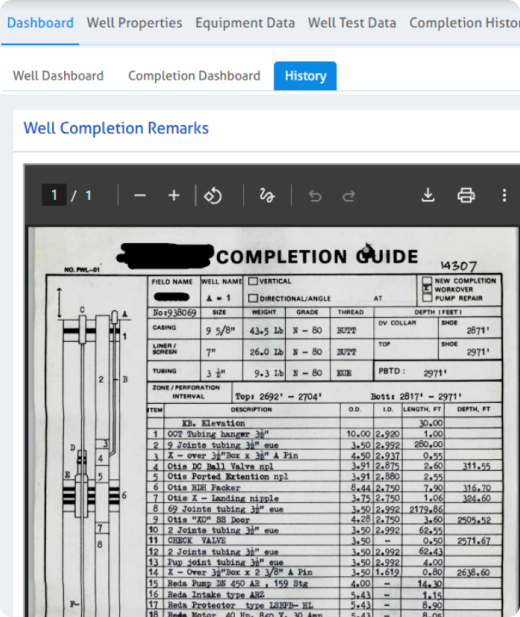
- Design and Equipment History: digital repository of all ALS configurations, VSDs, transformers, pumps, and surface cables — linking surface equipment to well performance and run life history.
- Mechanical State Management: continuous documentation of ALS installations — depth, stages, tubing configuration, electrical setup — enabling design comparison and scenario simulation.
- Component Load Analysis: monitoring of motor, seal, cable, and VSD loads, correlating surface and downhole conditions to anticipate integrity risks.
- Teardown Repository — DIFA: structured failure analysis database with visual evidence, metallographic results, and root cause classification — providing insights for reliability improvement and design feedback.
- Management KPIs: automated calculation of MTBF, MTTR, backlog, and failure rates — integrated into Optima dashboards for engineering, operations, and strategic decision-making.
- Procedures & Knowledge Base: centralised repository of SOPs, protocols, and lessons learned — standardising best practices and supporting continuous design improvement.
What Artificial Lift Lifecycle
Management Delivers


Extended ESP Run Life
Failure prediction, optimised setpoints, and load monitoring systematically extend the time between pulls — reducing workover frequency and intervention cost.


Reduced OPEX
kWh/bbl optimisation, inventory rationalisation, and planned vs. emergency intervention planning cut operational costs across the ALS programme.


Full Supply Chain Visibility
From purchase order to installation to pull — every ALS unit and every metre of cable is tracked, accountable, and auditable.


Compliance & Auditability
Blockchain-backed traceability, DIFA repositories, and automated documentation deliver the audit trail that operators and regulators require.
Take control of your
artificial lift programme.
Speak with our ALS specialists and discover how Optima's Artificial Lift Lifecycle solution can reduce your lifting cost, extend run life, and give you full visibility across your entire ESP and ALS operation.